

The missing fragment of Insight (Quadriga) - Das fehlende Fragment der Einsicht (Quadriga)
Awakening at the Lotus Shore - Erwachen am Lotus-Ufer
- 0 x 0 cm
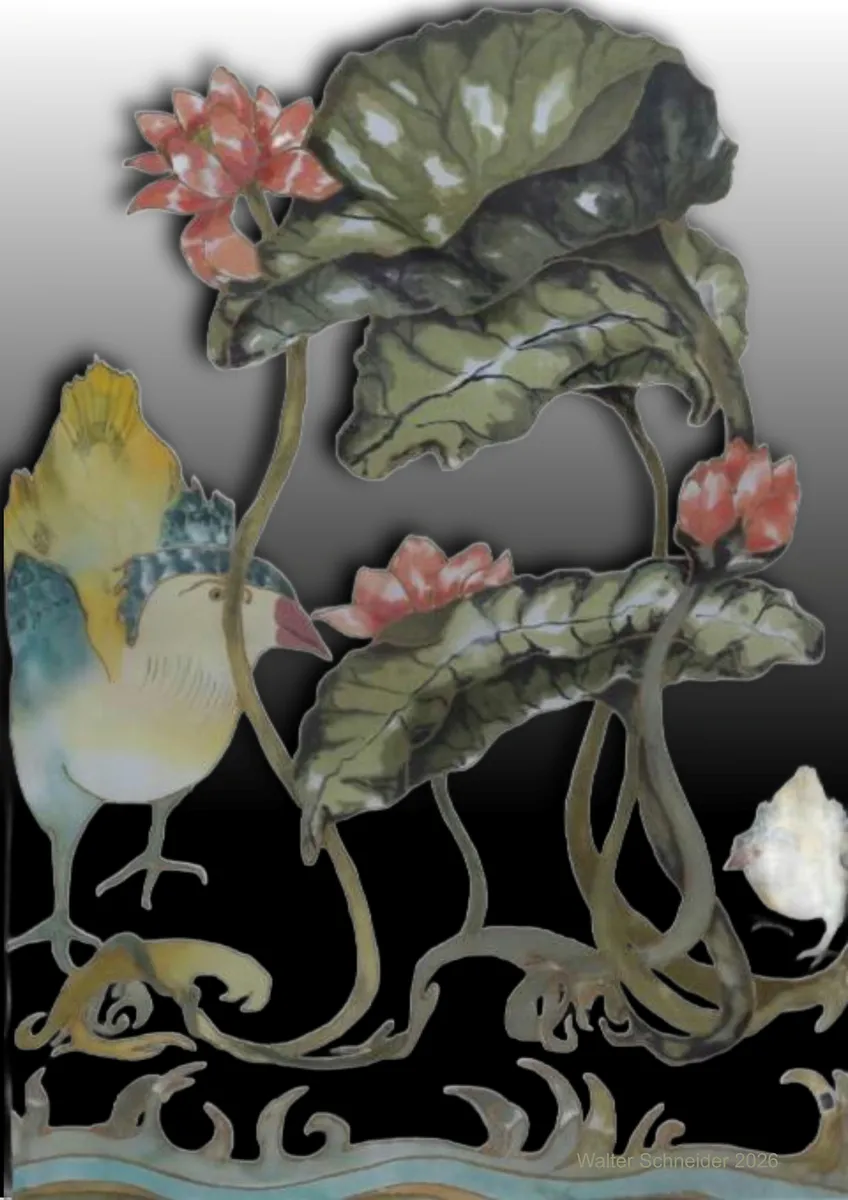
(Canvas & Fine Art Print / International Shipping) Art Style: The piece is done in a floral Art Nouveau style with clear influences of Japonism. The wavy patterns on the ground and the elegantly curved plant stems reflect the typically organic lines of this era. Image Description: The work depicts a stylized riverside scene with large lotus or water lily leaves, three salmon-colored flower buds, and two imaginatively patterned birds. A large bird with yellow-blue plumage stands in profile on the left, while on the right a smaller bird strolls on the ground. The intertwined stems grow up from a decorative, ornamental wave zone at the bottom of the image. Signed 'Walter Schneider 2026'. Image Analysis: Composition: Vertically oriented, asymmetrical arrangement, where the curved S-lines of the stems and leaves guide the eye dynamically through the image. Color and Light: Soft, matte earth tones and olive green dominate the vegetation, while the flowers in salmon pink and the plumage in yellow-blue create targeted accents. Texture: The texture allows for soft shading on the leaves, clearly defined by the typical fine contour lines. Perspective: Two-dimensional, flat representation without a pronounced vanishing point, where depth is primarily created through the layering and overlapping of the leaves.
2026
Graphic Art
Kunststil: Das Werk ist im floralen Jugendstil (Art Nouveau) mit deutlichen Einflüssen des Japonismus gehalten. Die wellenförmigen Wellenmotive am Boden und die elegant geschwungenen Pflanzenstängel spiegeln die typisch organische Linienführung dieser Epoche wider. Bildbeschreibung: Das Werk zeigt eine stilisierte Uferszene mit großen Lotus- oder Seerosenblättern, drei lachsfarbenen Blütenknospen und zwei fantasievoll gemusterten Vögeln. Ein großer Vogel mit gelb-blauem Gefieder steht links im Profil, während rechts ein kleinerer Vogel am Boden flaniert. Die verschlungenen Stängel wachsen aus einer dekorativen, ornamentalen Wellenzone am unteren Bildrand empor. Signatur „Walter Schneider 2026“. Bildanalyse: Komposition: Vertikal orientierte, asymmetrische Anordnung, bei der die geschwungenen S-Linien der Stängel und Blätter den Blick dynamisch durch das Bild leiten. Farbe und Licht: Sanfte, matte Erdtöne und Olivgrün dominieren die Vegetation, während die Blüten in Lachsrosa und das Gefieder in Gelb-Blau gezielte Akzente setzen. Textur: Die Textur ermöglicht weiche Schattierungen auf den Blättern, klar begrenzt durch die typischen, feinen Konturlinien. Perspektive: Zweidimensionale, flächige Darstellung ohne ausgeprägten Fluchtpunkt, bei der die Tiefe primär durch die Staffelung und Überlagerung der Blätter erzeugt wird.
The missing fragment of Insight No 4 (4 x Edition) -Das fehlende Fragment der Einsicht No 4 (4 x Edition)
- 0 x 0 cm
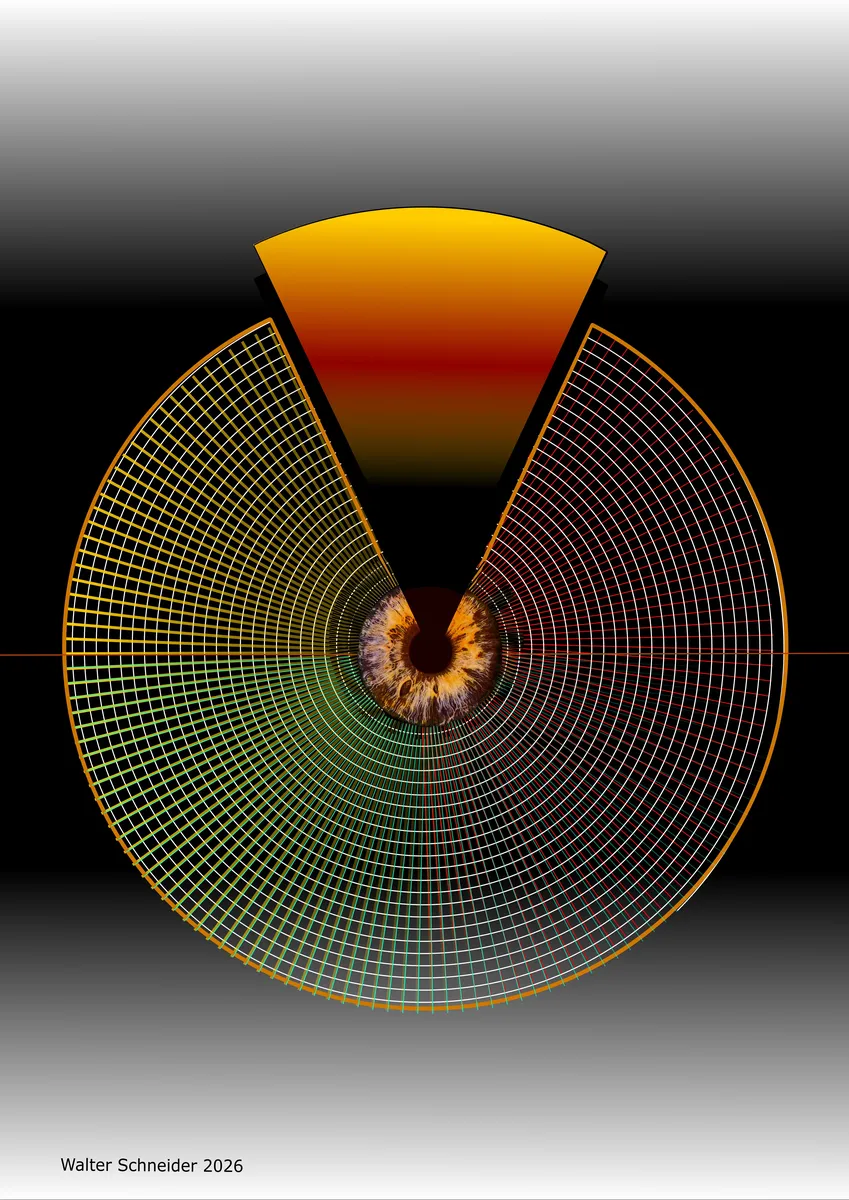
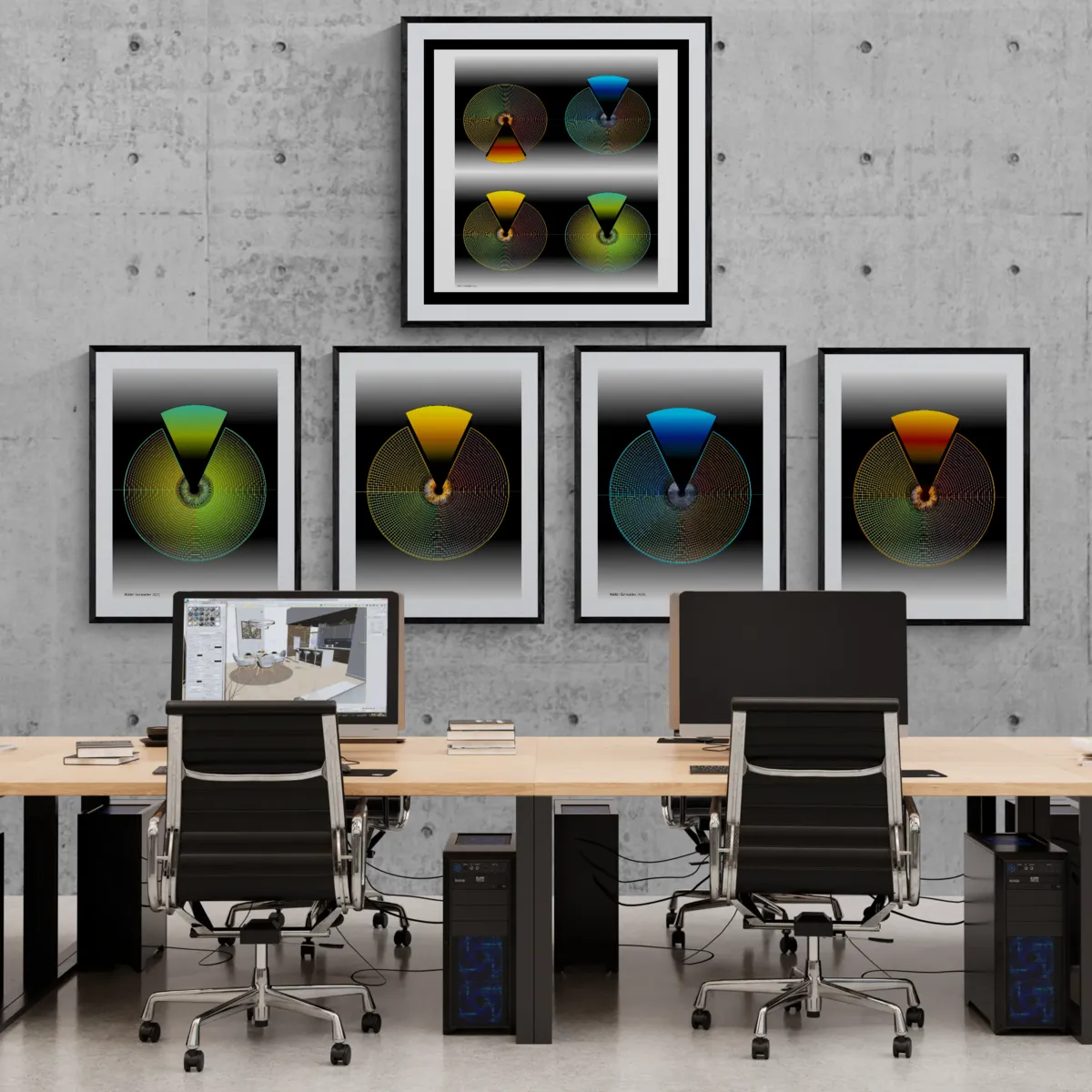
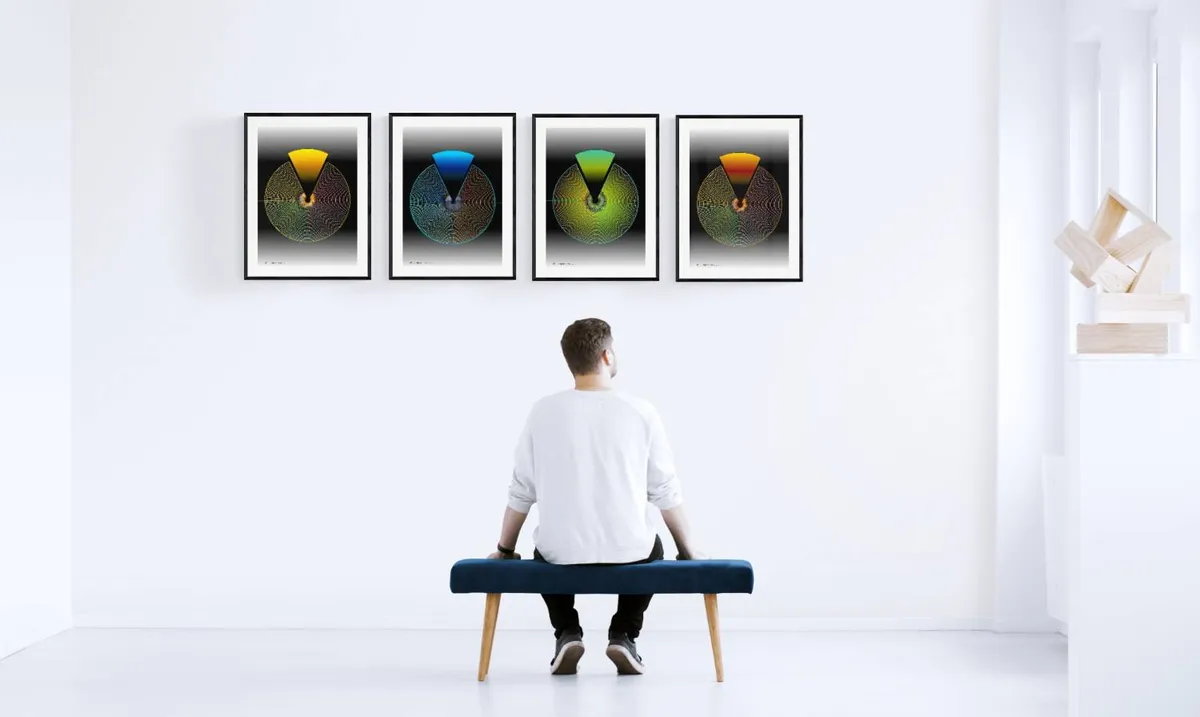
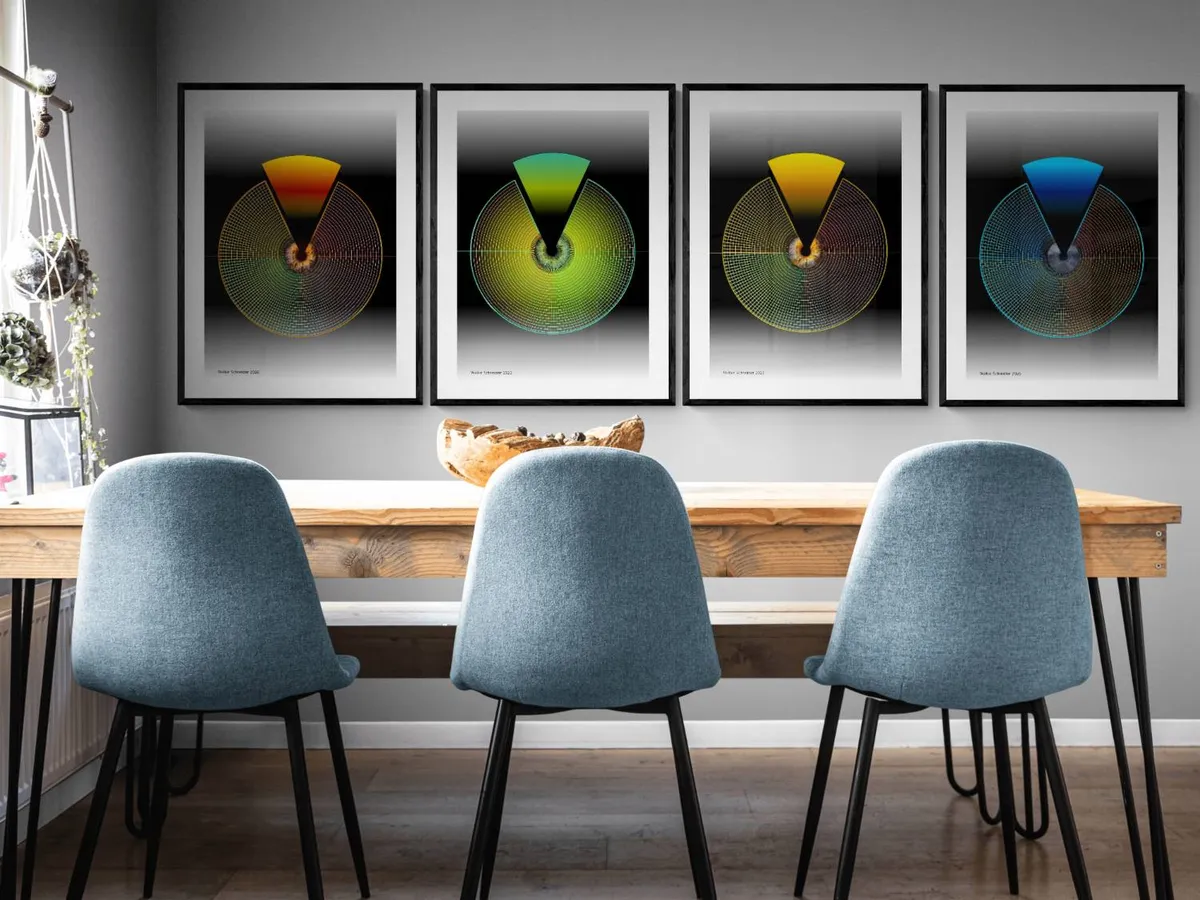
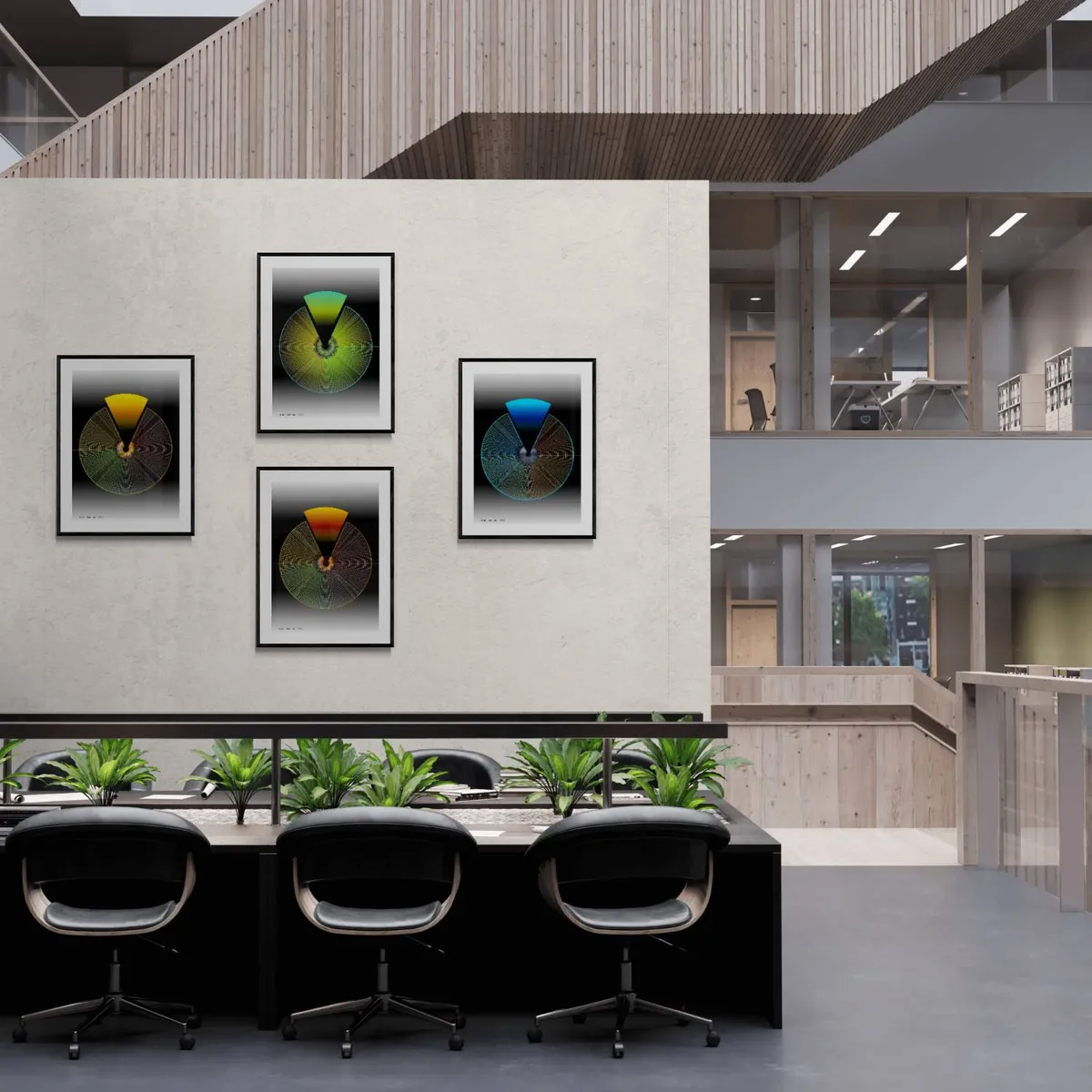
(Canvas & Fine Art Print / International Shipping) See also one attached picture with the full edition (4 pieces). Art Style Digital geometric abstraction in the style of Op Art (Optical Art) with elements of Kineticism and technoid information design. Image Description The four-part edition features a serial vector composition, where a fine circular grid structure in the center surrounds a photorealistic human iris. A sharp-edged, black wedge opens radially upward, revealing an intensely glowing, colored circular segment. Each work is subtly signed at the lower left corner with the white signature 'Walter Schneider 2026'. Image Analysis • Composition: Central circular symmetry, dynamically broken by a precisely measured, upward-opening pie slice segment (radial wedge); an ultra-thin horizontal horizon line divides the background. • Color and Light: Systematic color variation from left to right in green, yellow, blue, and red/orange; the light is dramatically focused in the top color wedge and contrasts with the soft light-to-dark gradient of the background. • Texture: Absolutely flawless digital vector aesthetic; the fine line grid creates a moiré-like optical vibration, strongly contrasting with the organic fiber texture of the central iris. • Perspective: Two-dimensional planimetry with strong depth effect (pseudo-perspective); the black wedge acts like a funnel, drawing the gaze straight into the center of the eye.
2023
Graphic Art
Siehe auch ein beigefügtes Bild mit der kompletten Ausgabe (4 Stück). Kunststil Digitale geometrische Abstraktion im Stil der Op-Art (Optical Art) mit Elementen des Kinetismus und des technoiden Informationsdesigns. Bildbeschreibung Die vierteilige Edition zeigt eine serielle Vektorkomposition, bei der eine feine Kreisgitter-Struktur im Zentrum eine fotorealistische, menschliche Iris umschließt. Ein scharfkantiger, schwarzer Keil öffnet sich radial nach oben und gibt den Blick auf ein intensiv leuchtendes, farbiges Kreissegment frei. Jedes Werk ist am unteren linken Rand dezent mit der weißen Signatur „Walter Schneider 2026“ versehen. Bildanalyse • Komposition: Zentrale Kreissymmetrie, die durch ein exakt bemessenes, sich nach oben öffnendes Tortenstück-Segment (radialer Keil) dynamisch aufgebrochen wird; eine hauchdünne horizontale Horizontlinie teilt den Hintergrund. • Farbe und Licht: Systematische Farbvariation von links nach rechts in Grün, Gelb, Blau und Rot/Orange; das Licht konzentriert sich dramatisch im oberen Farbkeil und kontrastiert mit dem weichen Hell-Dunkel-Verlauf des Hintergrunds. • Textur: Absolut makellose digitale Vektor-Ästhetik; die feinen Linienraster erzeugen eine moiré-artige, optische Schwingung, die in starkem Kontrast zur organischen Fasertextur der zentralen Iris steht. • Perspektive: Zweidimensionale Planmetrie mit starker Tiefenwirkung (Pseudoperspektive); der schwarze Keil wirkt wie ein Trichter, der den Blick saugstreifenartig direkt in das Zentrum des Auges leitet.
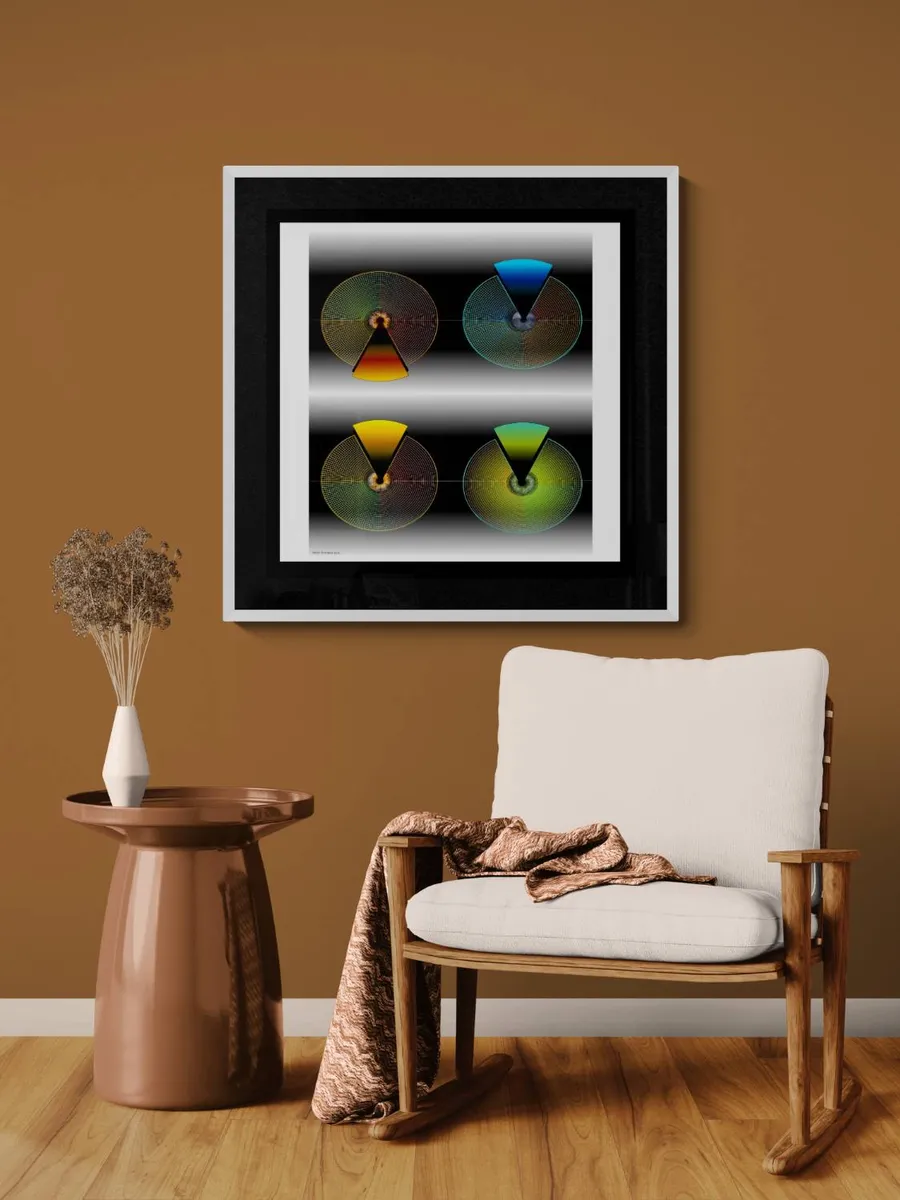
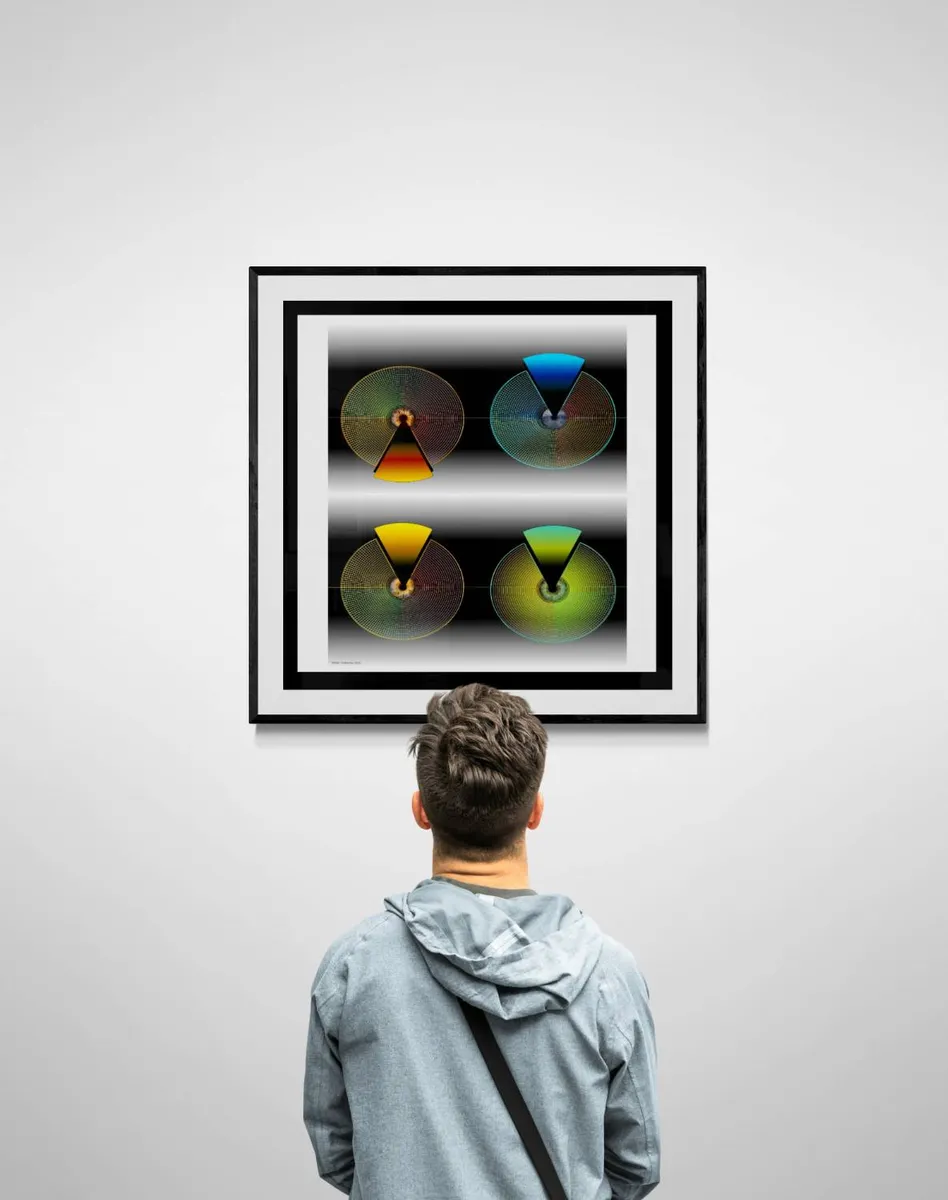
The missing fragment of Insight (Quadriga) - Das fehlende Fragment der Einsicht (Quadriga)
- null x null
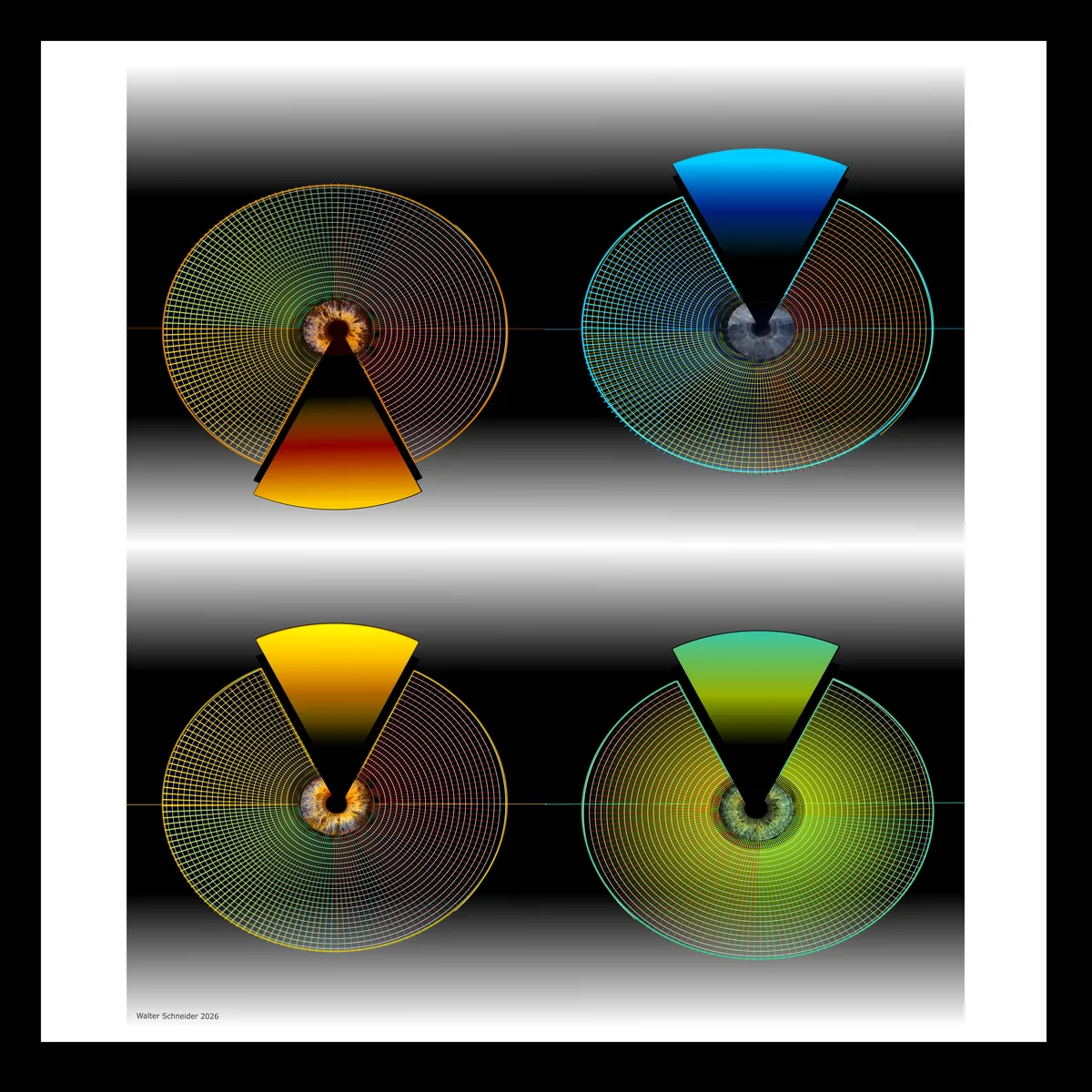
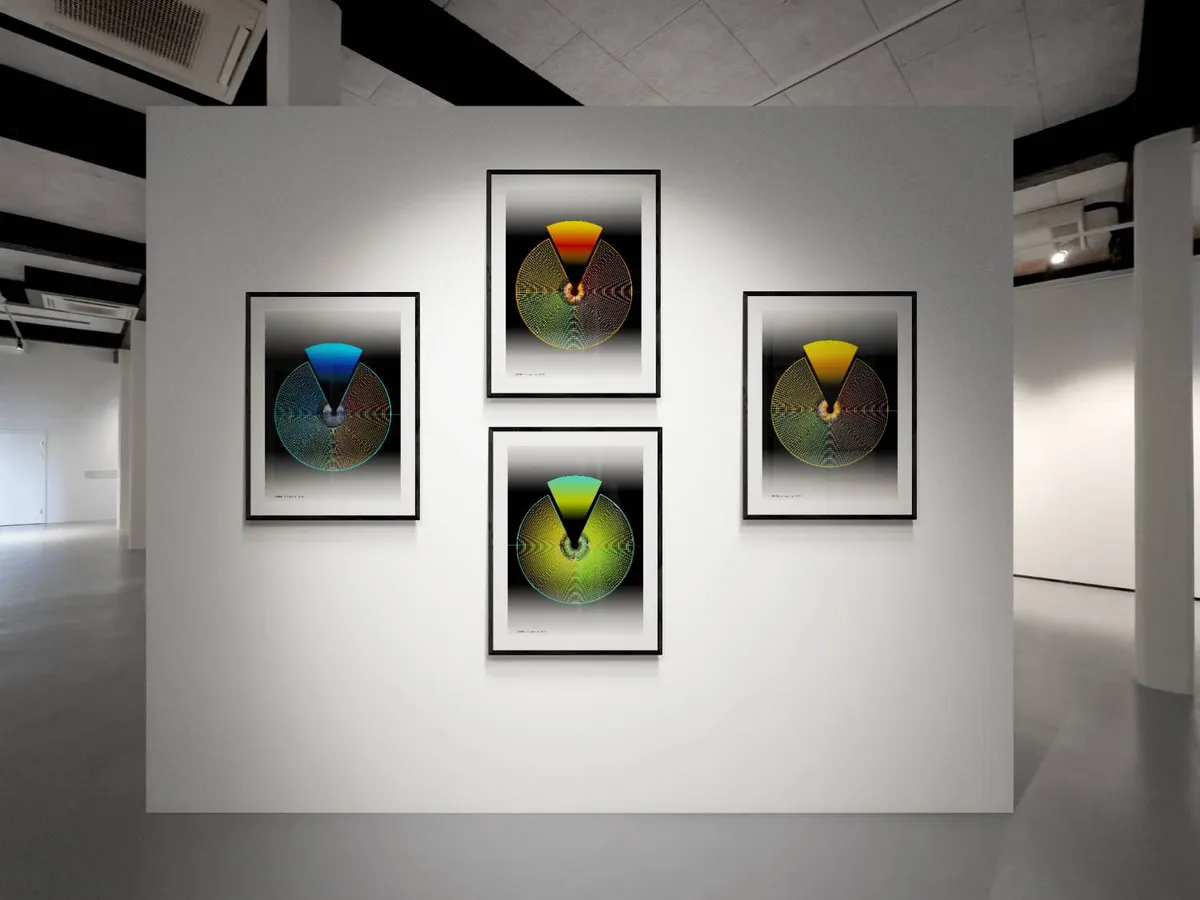
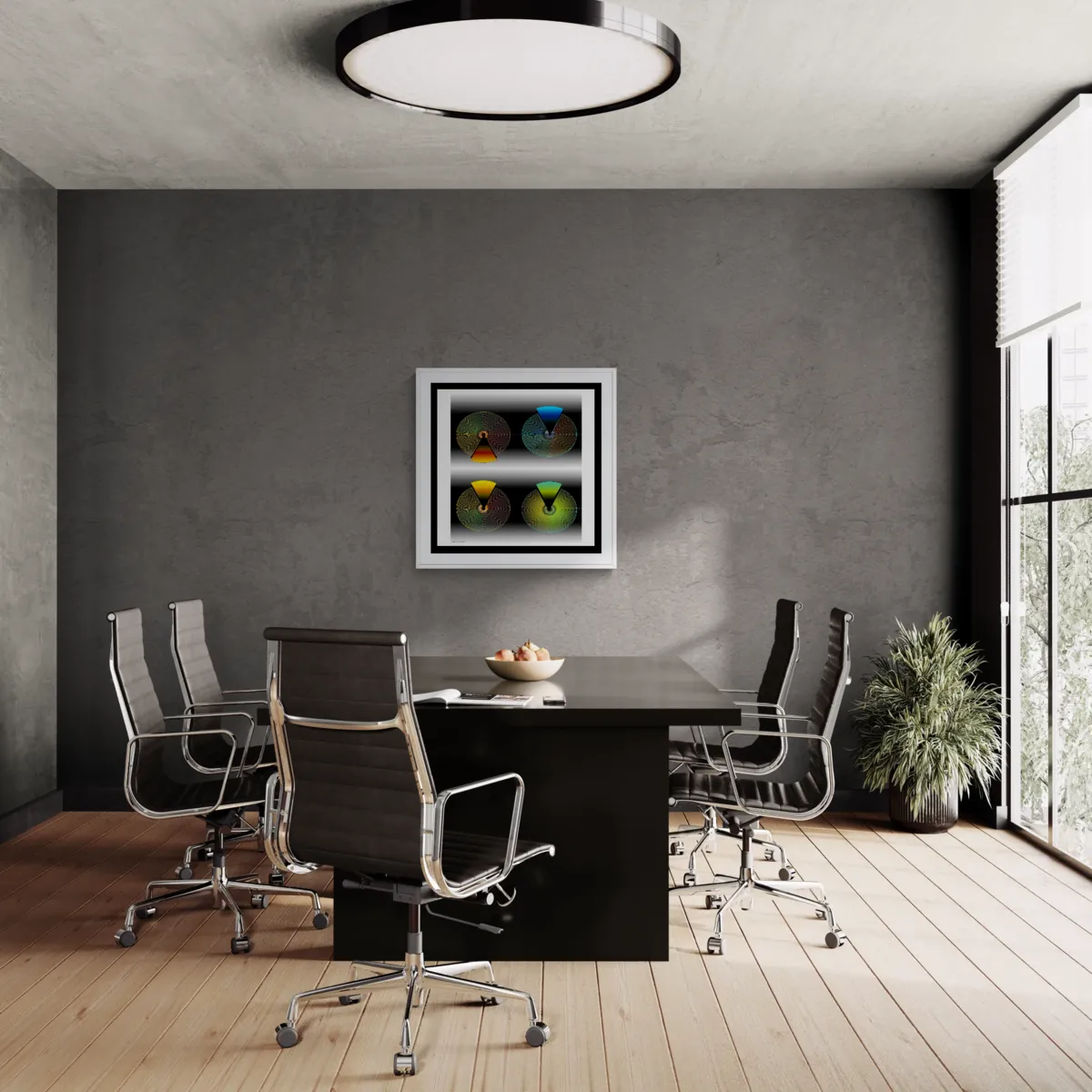
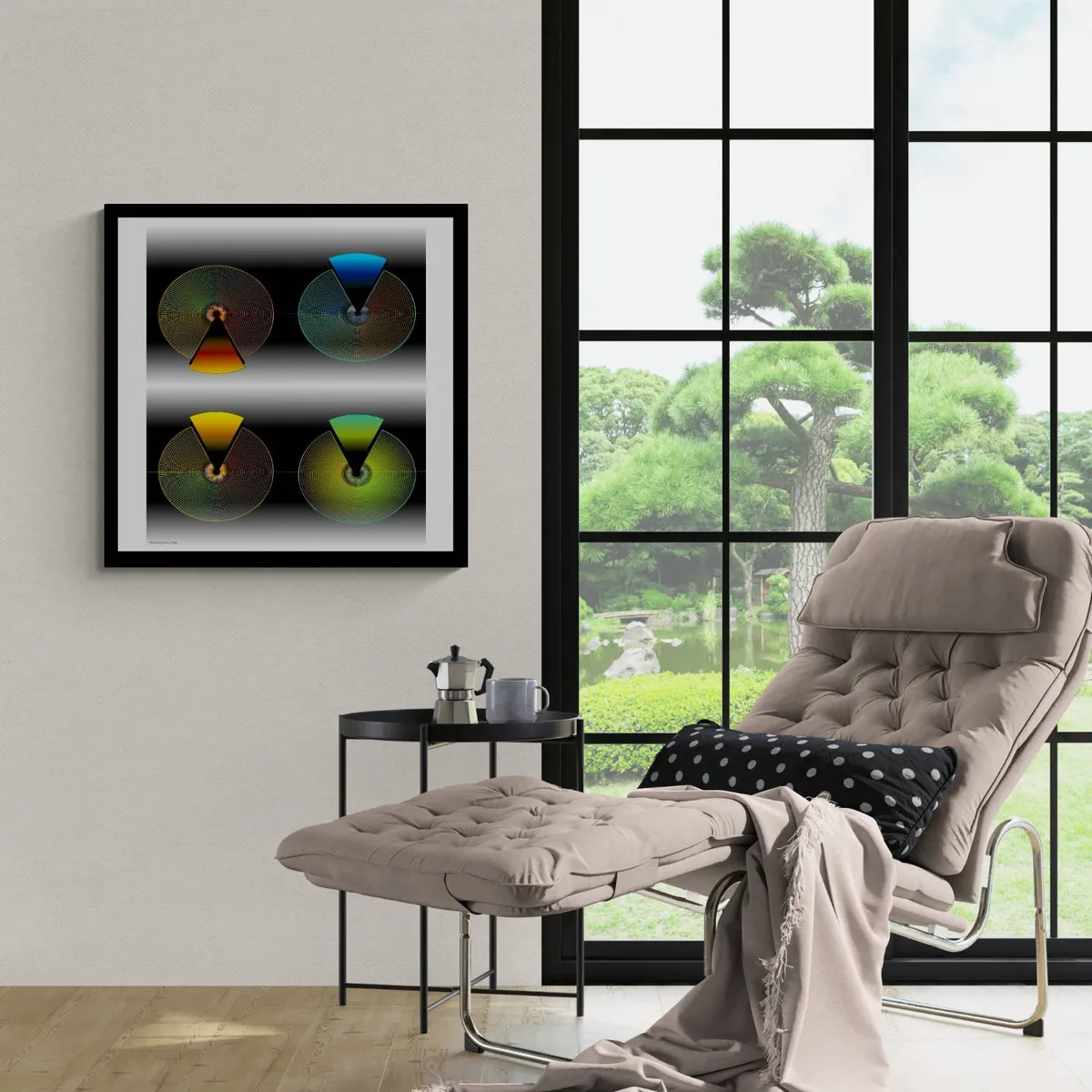
(Canvas & Fine Art Print / International Shipping) Art Style Digital geometric abstraction in the style of Op Art (Optical Art) with elements of Kineticism and technoid information design. Image Description The Quadriga edition features a serial vector composition, where a fine circular grid structure in the center surrounds a photorealistic human iris. A sharp-edged, black wedge opens radially upward, revealing an intensely glowing, colored circular segment. The artwork is subtly signed at the lower left corner with the white signature 'Walter Schneider 2026'. Image Analysis • Composition: Central circular symmetry, dynamically broken by a precisely measured, upward-opening pie slice segment (radial wedge); an ultra-thin horizontal horizon line divides the background. • Color and Light: Systematic color variation from left to right in green, yellow, blue, and red/orange; the light is dramatically focused in the top color wedge and contrasts with the soft light-to-dark gradient of the background. • Texture: Absolutely flawless digital vector aesthetic; the fine line grid creates a moiré-like optical vibration, strongly contrasting with the organic fiber texture of the central iris. • Perspective: Two-dimensional planimetry with strong depth effect (pseudo-perspective); the black wedge acts like a funnel, drawing the gaze straight into the center of the eye.
2026
Graphic Art
Kunststil Digitale geometrische Abstraktion im Stil der Op-Art (Optical Art) mit Elementen des Kinetismus und des technoiden Informationsdesigns. Bildbeschreibung Die Edition zeigt eine serielle Vektorkomposition, bei der eine feine Kreisgitter-Struktur im Zentrum eine fotorealistische, menschliche Iris umschließt. Ein scharfkantiger, schwarzer Keil öffnet sich radial nach oben und gibt den Blick auf ein intensiv leuchtendes, farbiges Kreissegment frei. Das Werk ist dezent mit der weißen Signatur „Walter Schneider 2026“ versehen. Bildanalyse • Komposition: Zentrale Kreissymmetrie, die durch ein exakt bemessenes, sich nach oben öffnendes Tortenstück-Segment (radialer Keil) dynamisch aufgebrochen wird; eine hauchdünne horizontale Horizontlinie teilt den Hintergrund. • Farbe und Licht: Systematische Farbvariation von links nach rechts in Grün, Gelb, Blau und Rot/Orange; das Licht konzentriert sich dramatisch im oberen Farbkeil und kontrastiert mit dem weichen Hell-Dunkel-Verlauf des Hintergrunds. • Textur: Absolut makellose digitale Vektor-Ästhetik; die feinen Linienraster erzeugen eine moiré-artige, optische Schwingung, die in starkem Kontrast zur organischen Fasertextur der zentralen Iris steht. • Perspektive: Zweidimensionale Planmetrie mit starker Tiefenwirkung (Pseudoperspektive); der schwarze Keil wirkt wie ein Trichter, der den Blick saugstreifenartig direkt in das Zentrum des Auges leitet.