

Floral climbing plant - Florales Rankengewächs
Hike into Rainbow Valley - Wanderung ins Regenbogental
- 0 x 0 cm
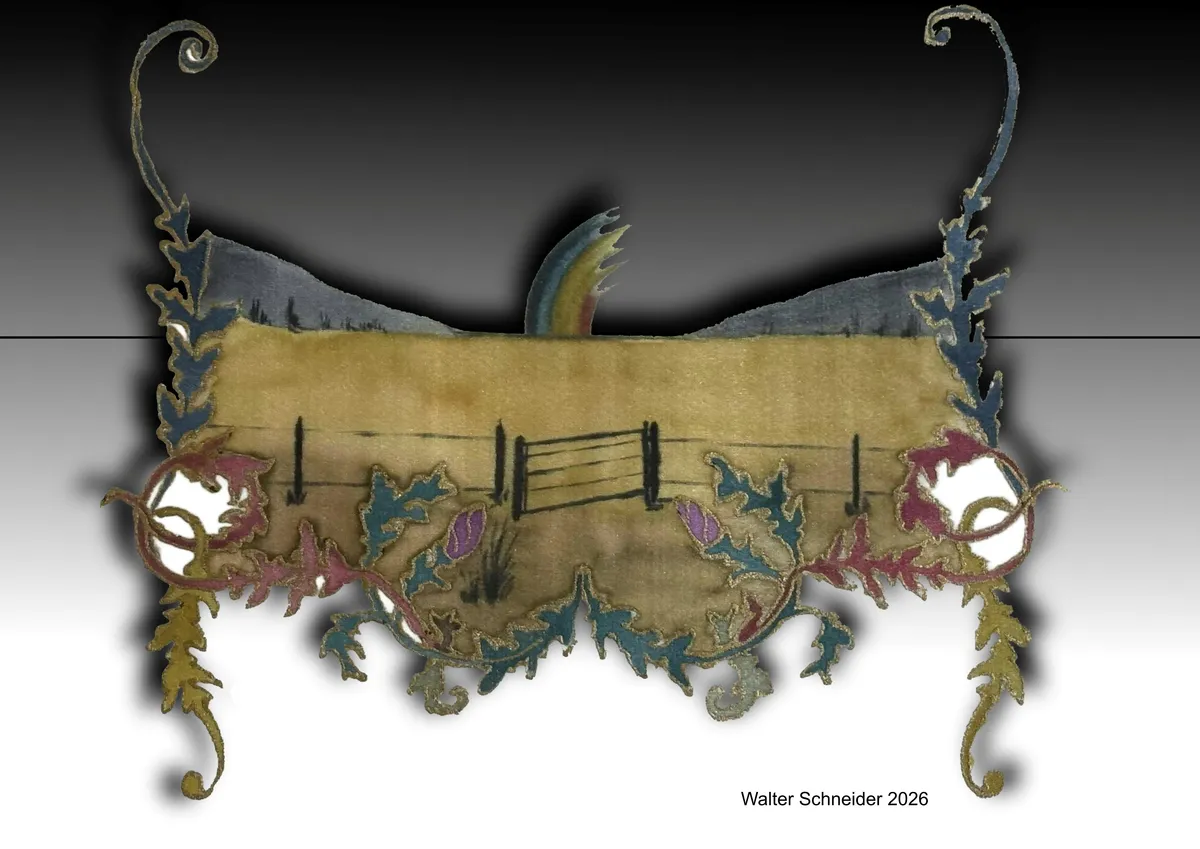
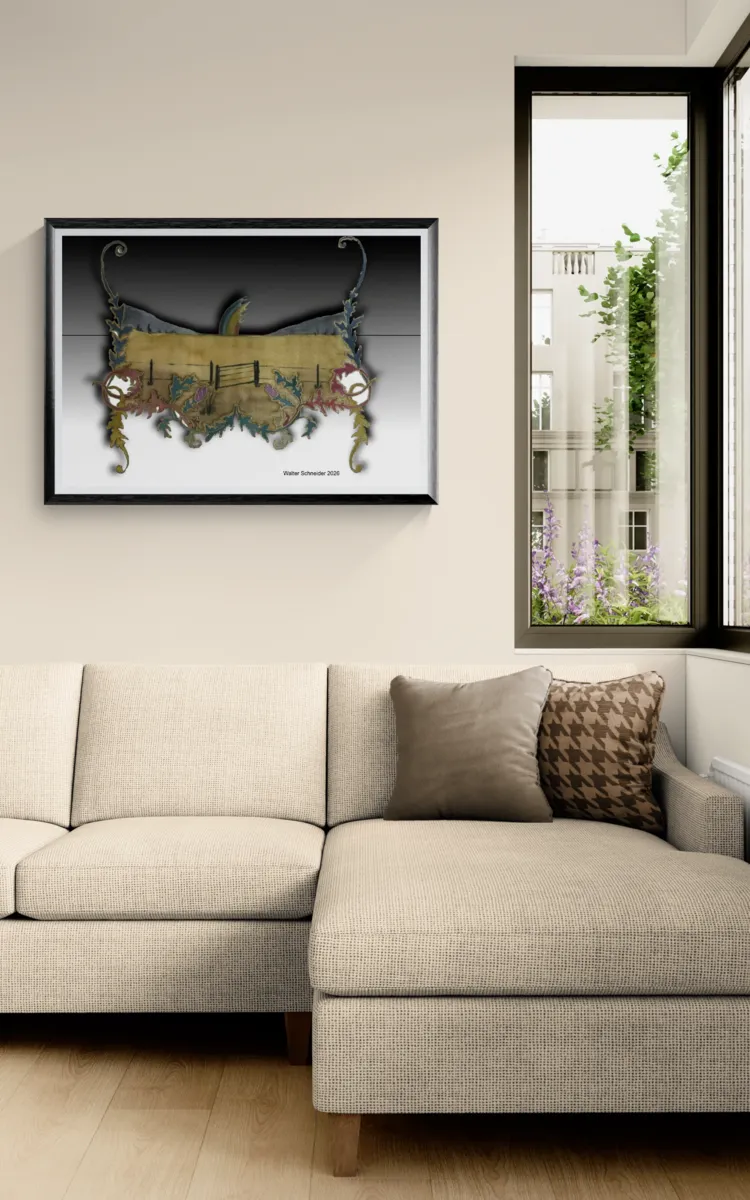
(Canvas & Fine Art Print / International Shipping) Art Style: Style: Surrealism influenced by elements of Art Nouveau and classical modernism. Image Description: The piece depicts a stylized landscape behind a wooden fence with a central gate. In the background, a striking, multicolored arch shape (rainbow/sun) rises behind hills under a gray sky. The scene is framed by symmetrical, delicate ornamental vines with floral elements and thistle motifs. Signed Walter Schneider 2026. Image Analysis: The work creates a sense of ornamental depth through the combination of the geometric fence and organic vines. The delicate flowing effects and fine line work make full use of transparency. The motif exudes a dreamy, melancholic calm. The vines act as a decorative stage, directing the viewer's gaze into the surreal interior of the landscape. Interpretation: 'Hike to Rainbow Valley' reflects the human longing that the hope for happiness is always to be found 'beyond the fence.' The visual focus (Rainbow Valley): In the center of the background, nestled between two ranges of hills, a striking, dynamically curved rainbow emerges. The hills form a natural valley, which represents the titular goal of the journey. The path and the obstacle (The hike): In the foreground stretches a wide, brown-yellow area, intersected by a pasture fence with a closed gate. This gate symbolizes the starting point or a hurdle on the way (the hike) across the valley toward the rainbow. It invites the viewer to mentally let their gaze wander over the fence into the distance. The fairytale-like frame: The artistic, floral ornamentation along the sides envelops the landscape like a portal.It reinforces the impression that you're peeking into a imaginative, almost mystical world – precisely into a 'Rainbow Valley'.
2026
Kunststil: Stilrichtung: Surrealismus geprägt von Elementen des Jugendstils (Art Nouveau) und der klassischen Moderne. Bildbeschreibung: Das Werk zeigt eine stilisierte Landschaft hinter einem Holzzaun mit zentralem Tor. Im Hintergrund geht eine markante, mehrfarbige Bogenform (Regenbogen/Sonne) hinter Hügeln unter grauem Himmel auf. Eingerahmt wird die Szenerie von symmetrischen, filigranen Ornamentranken mit floralen Elementen und Distelmotiven. Signatur Walter Schneider 2026“. Bildanalyse: Die Arbeit erzeugt durch die Kombination aus geometrischem Zaun und organischen Ranken eine ornamentale Tiefenwirkung. Die zarten Fließeffekte und die feine Linienführung nutzen die Transparenz optimal aus. Das Motiv strahlt eine traumhafte, melancholische Ruhe aus. Die Ranken fungieren als dekorative Bühne, die den Blick ins surreale Innere der Landschaft lenkt. Interpretation: „Wanderung ins Regenbogental“ widerspiegelt die menschliche Sehnsucht, dass die Hoffnung auf Glück immer „hinter dem Zaun“ zu finden ist. Der visuelle Fokus (Das Regenbogental): Im Zentrum des Hintergrunds, eingebettet zwischen zwei Hügelketten, bricht ein markanter, dynamisch geschwungener Regenbogen hervor. Die Hügel formen ein natürliches Tal, welches das titelgebende Ziel der Reise darstellt. Der Weg und das Hindernis (Die Wanderung): Im Vordergrund erstreckt sich eine weite, braun-gelbe Fläche, die von einem Weidezaun mit einem geschlossenen Tor durchzogen wird. Dieses Tor symbolisiert den Ausgangspunkt oder eine Hürde auf dem Weg (der Wanderung) hinters Tal zum Regenbogen. Es lädt den Betrachter ein, den Blick gedanklich über den Zaun hinweg in die Ferne schweifen zu lassen. Der märchenhafte Rahmen: Die kunstvolle, florale Ornamentik an den Seiten umschließt die Landschaft wie ein Portal. Sie verstärkt den Eindruck, dass man hier in eine fantasievolle, fast mystische Welt hineinblickt – eben in ein „Regenbogental“.
Awakening at the Lotus Shore - Erwachen am Lotus-Ufer
- 0 x 0 cm
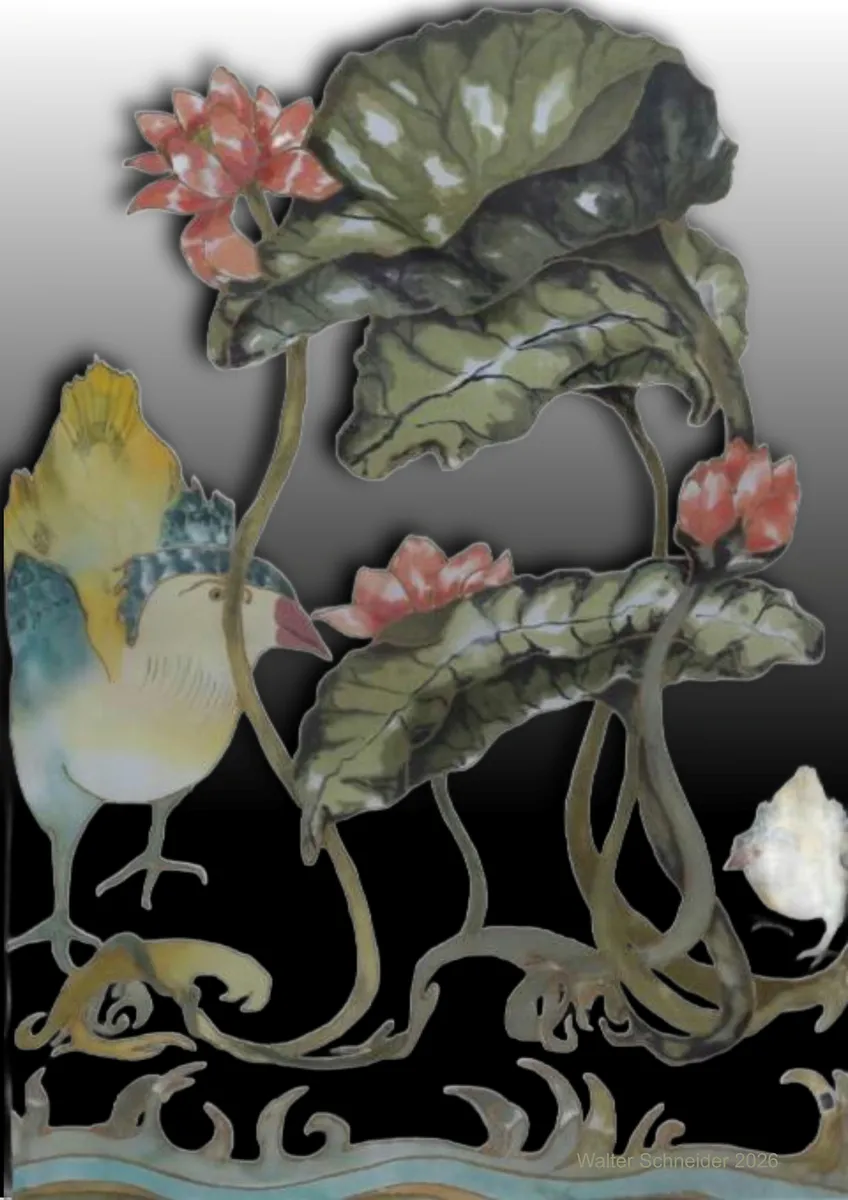
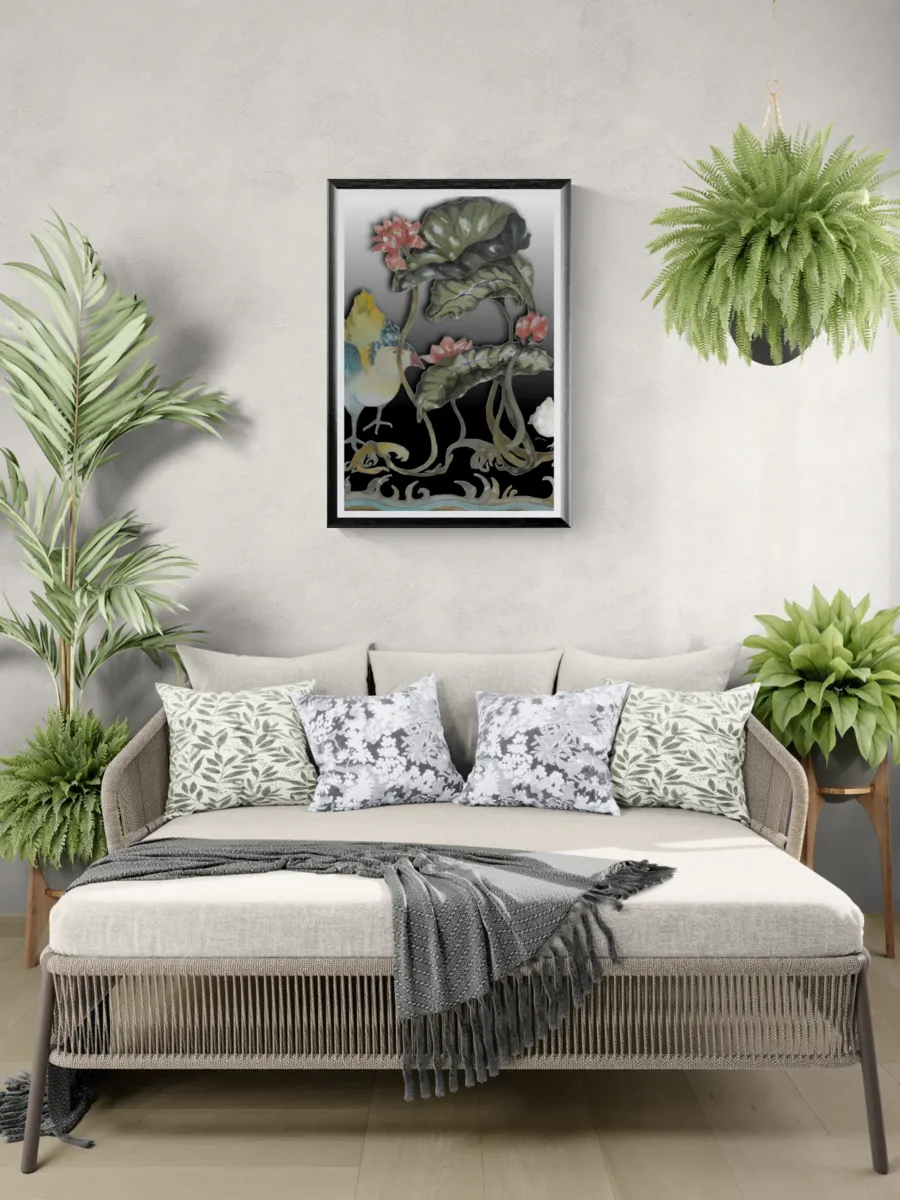
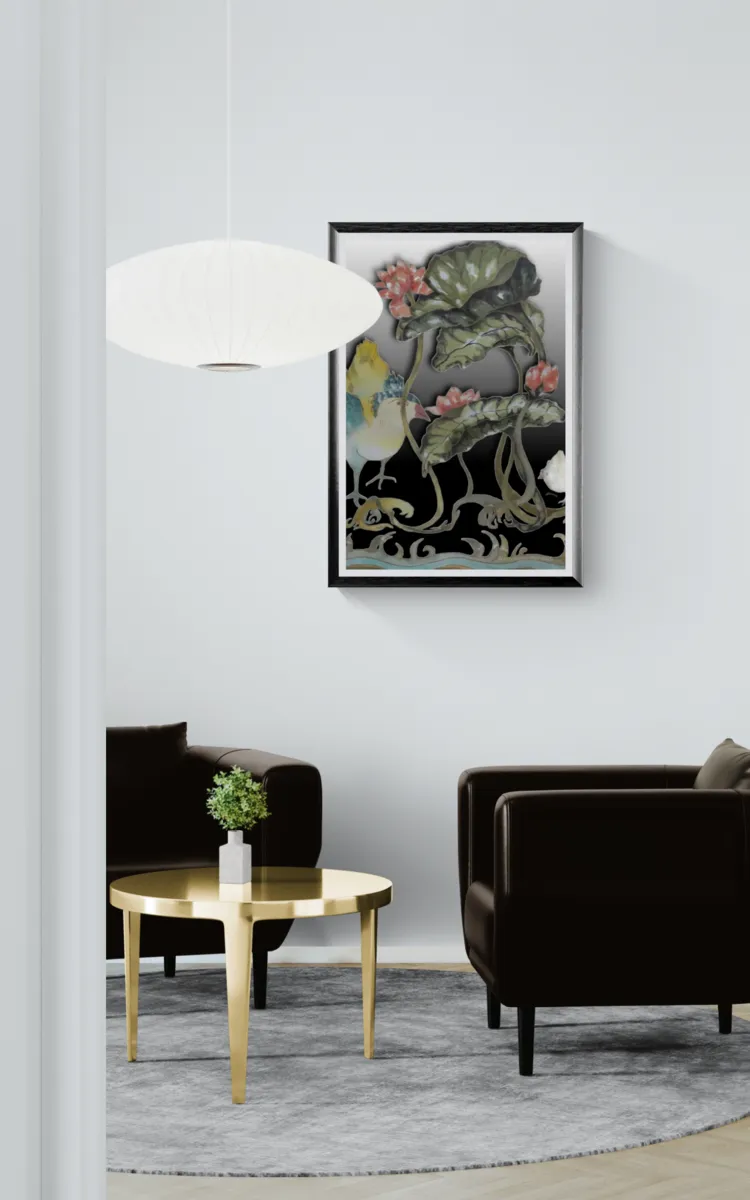
(Canvas & Fine Art Print / International Shipping) Art Style: The piece is done in a floral Art Nouveau style with clear influences of Japonism. The wavy patterns on the ground and the elegantly curved plant stems reflect the typically organic lines of this era. Image Description: The work depicts a stylized riverside scene with large lotus or water lily leaves, three salmon-colored flower buds, and two imaginatively patterned birds. A large bird with yellow-blue plumage stands in profile on the left, while on the right a smaller bird strolls on the ground. The intertwined stems grow up from a decorative, ornamental wave zone at the bottom of the image. Signed 'Walter Schneider 2026'. Image Analysis: Composition: Vertically oriented, asymmetrical arrangement, where the curved S-lines of the stems and leaves guide the eye dynamically through the image. Color and Light: Soft, matte earth tones and olive green dominate the vegetation, while the flowers in salmon pink and the plumage in yellow-blue create targeted accents. Texture: The texture allows for soft shading on the leaves, clearly defined by the typical fine contour lines. Perspective: Two-dimensional, flat representation without a pronounced vanishing point, where depth is primarily created through the layering and overlapping of the leaves.
2026
Graphic Art
Kunststil: Das Werk ist im floralen Jugendstil (Art Nouveau) mit deutlichen Einflüssen des Japonismus gehalten. Die wellenförmigen Wellenmotive am Boden und die elegant geschwungenen Pflanzenstängel spiegeln die typisch organische Linienführung dieser Epoche wider. Bildbeschreibung: Das Werk zeigt eine stilisierte Uferszene mit großen Lotus- oder Seerosenblättern, drei lachsfarbenen Blütenknospen und zwei fantasievoll gemusterten Vögeln. Ein großer Vogel mit gelb-blauem Gefieder steht links im Profil, während rechts ein kleinerer Vogel am Boden flaniert. Die verschlungenen Stängel wachsen aus einer dekorativen, ornamentalen Wellenzone am unteren Bildrand empor. Signatur „Walter Schneider 2026“. Bildanalyse: Komposition: Vertikal orientierte, asymmetrische Anordnung, bei der die geschwungenen S-Linien der Stängel und Blätter den Blick dynamisch durch das Bild leiten. Farbe und Licht: Sanfte, matte Erdtöne und Olivgrün dominieren die Vegetation, während die Blüten in Lachsrosa und das Gefieder in Gelb-Blau gezielte Akzente setzen. Textur: Die Textur ermöglicht weiche Schattierungen auf den Blättern, klar begrenzt durch die typischen, feinen Konturlinien. Perspektive: Zweidimensionale, flächige Darstellung ohne ausgeprägten Fluchtpunkt, bei der die Tiefe primär durch die Staffelung und Überlagerung der Blätter erzeugt wird.
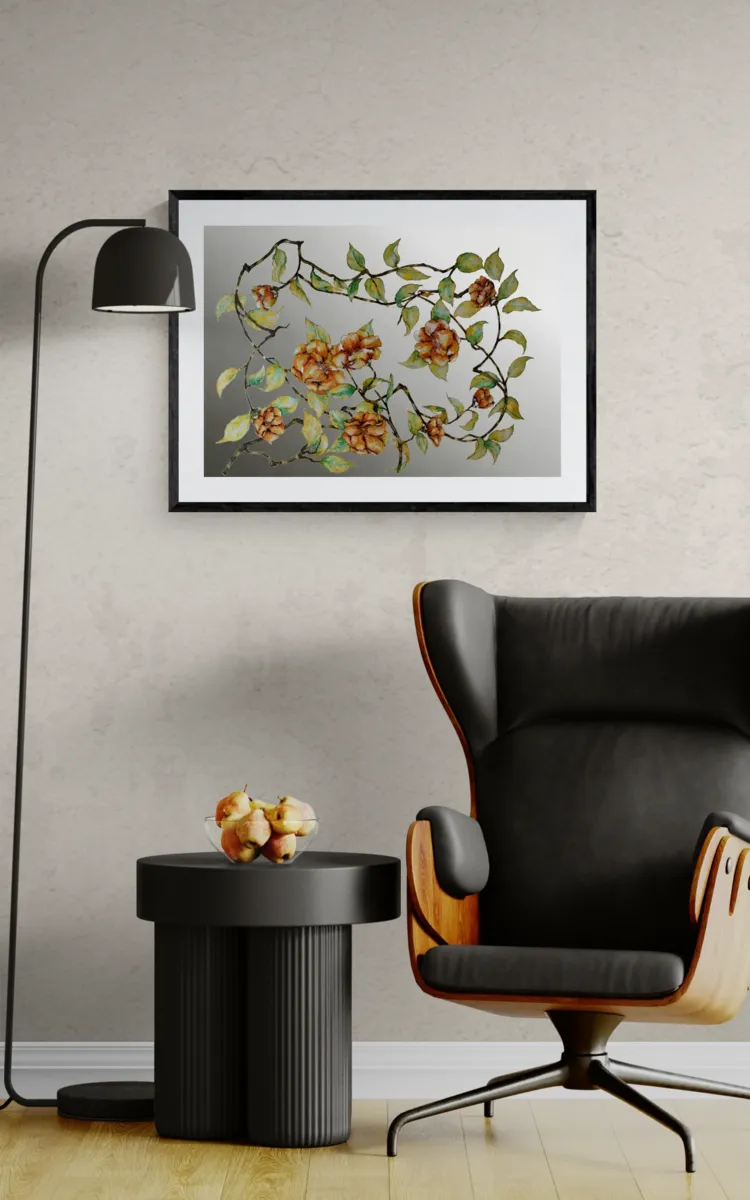
Floral climbing plant - Florales Rankengewächs
- 0 x 0 cm
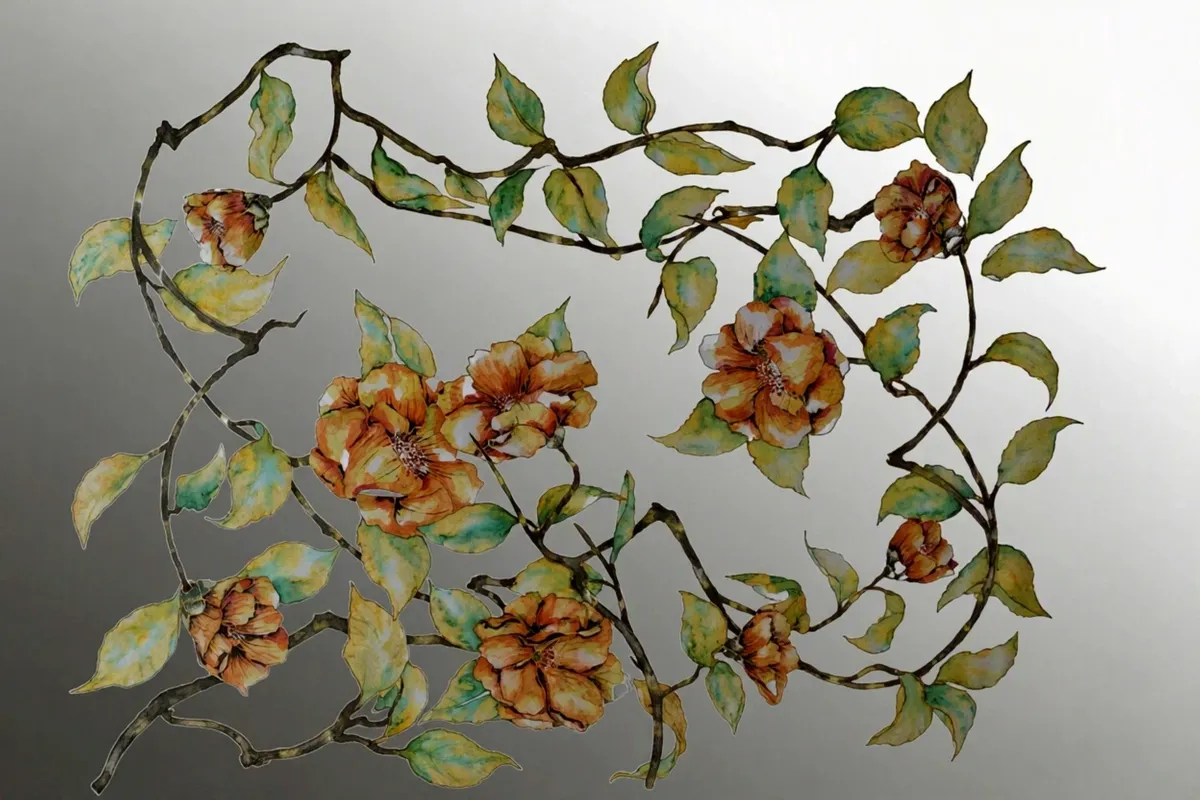
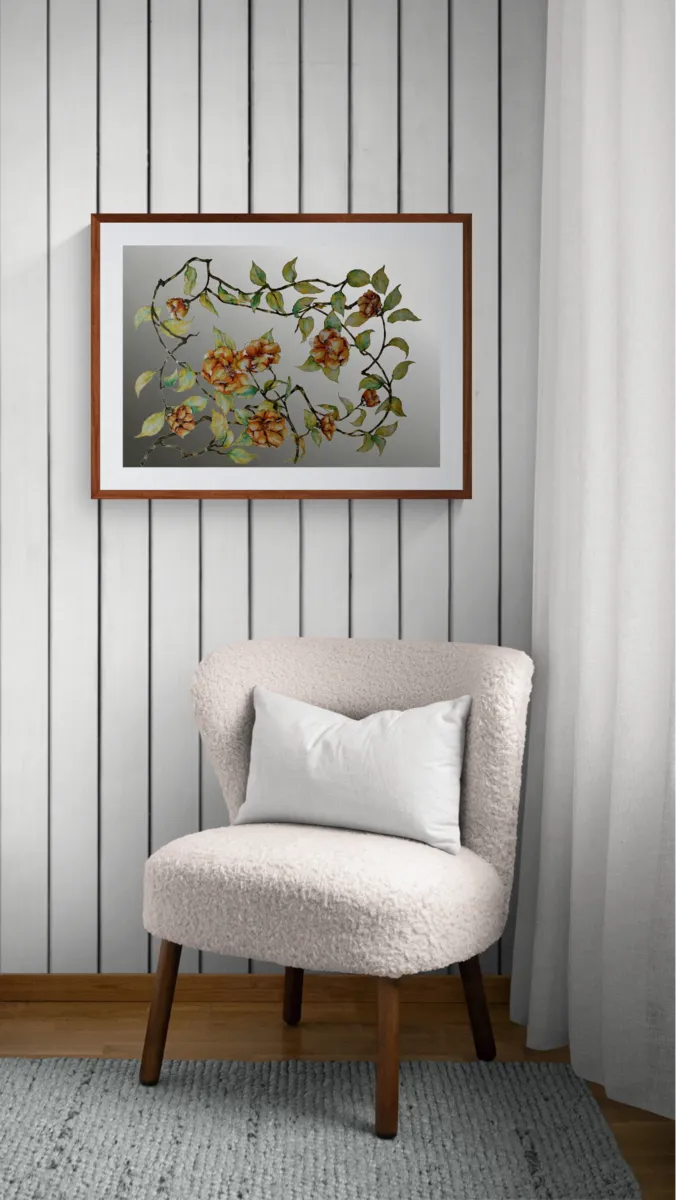
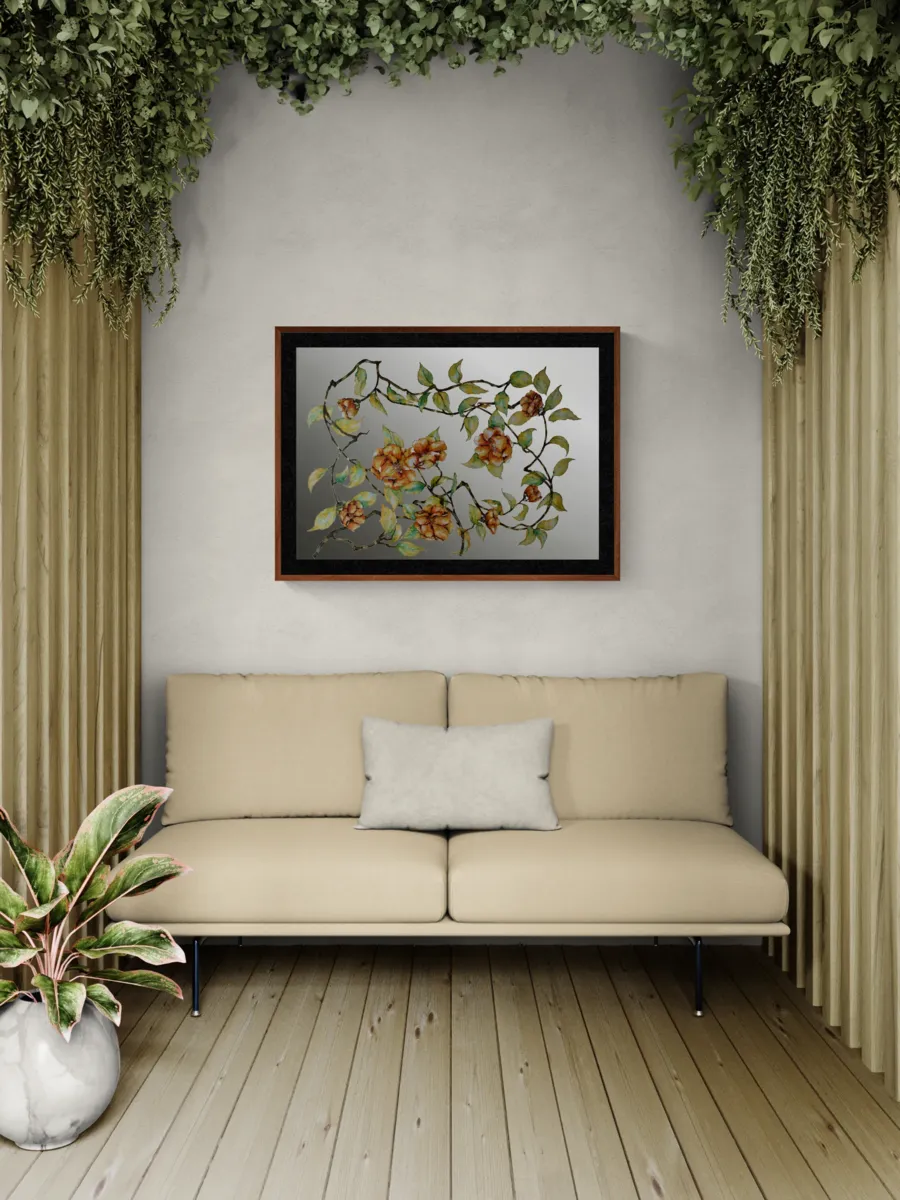
(Canvas & Fine Art Print / International Shipping) Art Style: The artwork is done in a floral Art Nouveau style with clear influences of Japonism. The "all-over" plant network and organically twisted branches perfectly reflect the flowing lines of this era. Image Description: The picture shows a dense, dynamic mesh of dark brown branches extending across the entire canvas. Numerous leaves in delicate green-yellow shades and several open, orange-golden blossoms reminiscent of camellias or peonies grow from them. The floral pattern almost completely fills the image and feels like a snippet from an endless vine. Signature "Walter Schneider 2026" Image Analysis: Composition: A rhythmic, all-over pattern where the curved branches cross diagonally and the flowers are distributed asymmetrically as visual anchor points. Color and Light: Warm, bright orange and ochre tones of the flowers harmoniously contrast with the fresh yellow-green of the leaves against a neutral background. Texture: The smooth surface of the silk allows the colors within the leaves and flowers to blend softly, while the dark branch lines add a graphic sharpness. Perspective: Purely two-dimensional, decorative surface representation without spatial depth or shadow, reminiscent of the flat aesthetic of East Asian textile art.
2026
Graphic Art
Kunststil: Das Kunstwerk ist im floralen Jugendstil (Art Nouveau) mit deutlichen Einflüssen des Japonismus gehalten. Das „all-over“ verteilte Pflanzennetzwerk und die organisch gewundenen Äste spiegeln die fließende Linienführung dieser Epoche perfekt wider. Bildbeschreibung: Das Bild zeigt ein dichtes, dynamisches Geflecht aus dunkelbraunen Zweigen, das sich über die gesamte Bildfläche erstreckt. Daran wachsen zahlreiche, zart grüngelb schattierte Blätter und mehrere geöffnete, orange-goldene Blüten, die an Kamelien oder Pfingstrosen erinnern. Das florale Muster füllt die Bildfläche fast vollständig aus und wirkt wie ein Ausschnitt aus einer unendlichen Ranke. Signatur „Walter Schneider 2026“ Bildanalyse: Komposition: Ein rhythmisches, flächendeckendes „All-over-Pattern“, bei dem sich die geschwungenen Äste diagonal kreuzen und die Blüten asymmetrisch als visuelle Ankerpunkte verteilt sind. Farbe und Licht: Warme, leuchtende Orange- und Ockertöne der Blüten kontrastieren harmonisch mit dem frischen Gelbgrün der Blätter vor einem neutralen Hintergrund. Textur: Die glatte Oberflächenstruktur der Seide lässt die Farben innerhalb der Blätter und Blüten weich ineinanderfließen, während die dunklen Astlinien grafische Härte einbringen. Perspektive: Reine zweidimensionale, dekorative Flächendarstellung ohne räumliche Tiefe oder Schattenwurf, die an die flächige Ästhetik ostasiatischer Textilkunst erinnert.